Measuring Ourselves Against Outcomes: Nuvo AI's First Month in Production
April 16, 2026
Share:
At launch, we committed to four outcomes our customers consistently tell us they care about most. One month in, here's where Nuvo AI actually stands against each one, what's live, what it's driving on real shipments, and what's coming next.
A month ago, we introduced Nuvo AI, the first AI-native freight execution engine for North American Supply Chains. Nuvo AI represents a shift beyond traditional freight brokerage and point logistics tools. It replaces manual coordination with a system of specialized AI agents that execute freight end-to-end — combining pricing, sourcing, execution, visibility, and audit into a single operating layer.
Operating natively on NuvoOS, Nuvo AI handles the full lifecycle of a load with exceptionally low latency. It seamlessly ingests orders directly from your ERP (EDI, API or as simple as an email report), prices them against the live market, sources capacity from our 300K+ carrier network, executes with real-time tracking, and closes the loop with line-by-line invoice audits.
These agents are built for the kinds of supply chains where execution speed and reliability directly shape the bottom line. As our founder Deepak noted at launch, most AI in freight today is sold as a small feature bolted onto a legacy process. Nuvo AI is a complete rethink of what execution can be. We designed it to handle complex, high-volume logistics autonomously, applying AI directly to the four customer outcomes we hold ourselves accountable to:
Reducing freight spend
Improving service levels
Radically simplifying your logistics tech stack
Staying ahead on AI
This update is a snapshot of how Nuvo AI is delivering against each one today, what agents are live in production, what they actually do, what results they're driving across real shipments, and what's coming next.
At a glance
Outcome
What's live today
Result
Reducing freight spend
Quote, Negotiation, Audit agents
7–20% avg. year-one spend reduction
Improving service levels
Dispatch, Tracking, Exception agents + Control Tower
95%+ on-time delivery
Radically simplifying your logistics tech stack
NuvoOS + 12+ integrated agents across the full load lifecycle
70%+ of load lifecycle automated
Staying ahead on AI
Continuous vendor evaluation, foundation model agility, embedded freight experts
8% purchasing power vs. market
1. Reducing freight spend
The North American freight market is entering an inflationary cycle. Spot linehaul rates have climbed roughly 28% in under a year, carrier capacity is tightening, and diesel recently saw its largest weekly spike on record. In an environment like this, being passive about freight spend is one of the fastest ways to watch costs balloon.
Avoiding that outcome isn't about any single tactic. It's about doing six things consistently on every load: holding providers accountable to rates benchmarked against the market, running bids consistently for both contract and spot, enforcing routing-guide discipline, accessing as much carrier capacity as possible to maximize competitive tension, running a robust spot motion for when the market shifts, and automating the grunt work that would otherwise drain your team. Most shippers know this. The challenge is executing it well, consistently, across every load, which is an enormous operational lift without the right technology.
That's exactly what Nuvo AI's pricing and sourcing agents are built for.
Bids, benchmarks, and audits on every load
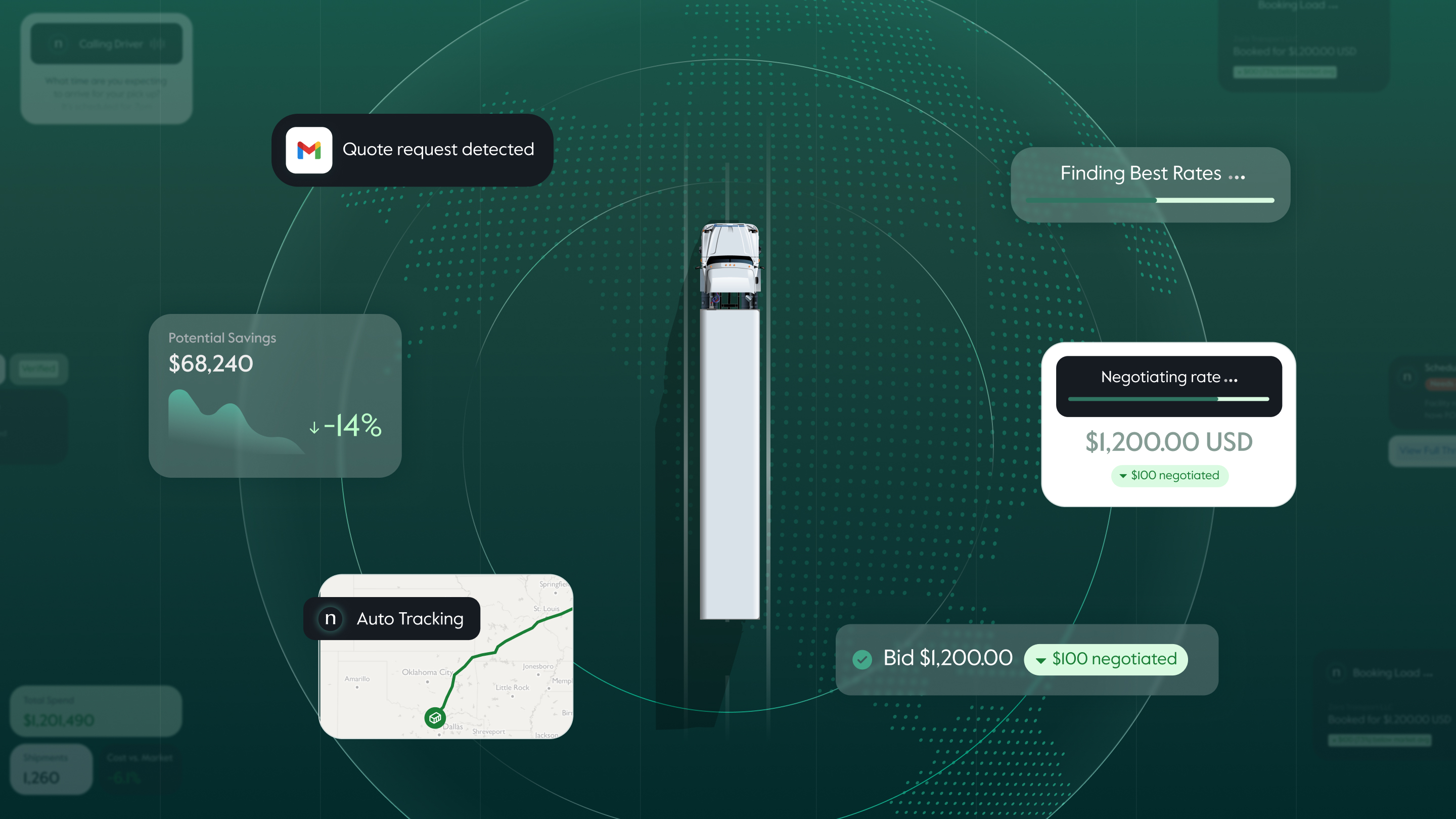
The Quote Agent instantly reaches dozens of carriers from our 300K+ network, collects live bids, and benchmarks every rate against real-time market behavior. The Negotiation Agent negotiates with multiple carriers in parallel rather than sequentially, locking the best compliant rate the moment it appears. Once a load is delivered, the Audit Agent reviews rates, accessorials, and every invoice line item, catching discrepancies that would otherwise flow through unchecked.
Here's what that looks like on an actual recent shipment:
Load booked for $1,150 against a market average of $1,270, 15 bids received, 32 carriers contacted, AI-led negotiations reduced costs by 7%. Carrier passed compliance checks automatically. Prior-12-load history on the lane: low $1,100, average $1,175, keeping the booking comfortably inside expected variance.
Multiply that pattern across thousands of shipments per customer, and the impact compounds:
7–20% average freight spend reduction in year one
8% greater purchasing power vs. market rates
Every load bid against the live market, never a static rate card
2. Improving service levels
Reducing spend matters. Doing it without breaking service matters more.
As freight volume grows, the supply chain fragments. New destinations, new retailers, new distributors, new carriers, each with different expectations. Internal transfers work differently from end-customer deliveries. Retailer appointments have zero tolerance for miss. Across all of it, the fundamentals stay constant: shipments picked up and delivered on time, carriers meeting their commitments, and a clean record of what happened so the business can improve. The metrics that matter: on-time pickup, on-time delivery, OTIF, landed cost per shipment, landed cost per SKU, are metrics every shipper knows. Very few have a clean way to track them without stitching data across five or more tools.
Every load, watched in real time
As soon as a load is awarded, the Dispatch Agent confirms driver assignment, captures the empty trailer's location, verifies trailer requirements (food-grade, strap count, hazmat endorsement), and establishes phone contact with the driver, all before the truck reaches the pickup. The Tracking Agent then runs automated touchpoints every 15 minutes across ELD, GPS, and driver-phone data, monitoring thousands of concurrent shipments for dwell, drift, and routing issues. When something deviates, the Exception Agent intervenes in real time — handling 12+ exception types today, including mechanical breakdown, cargo damage, trailer detention, FDA inspection, traffic conditions, deadhead timing issues, and trailer seal integrity.
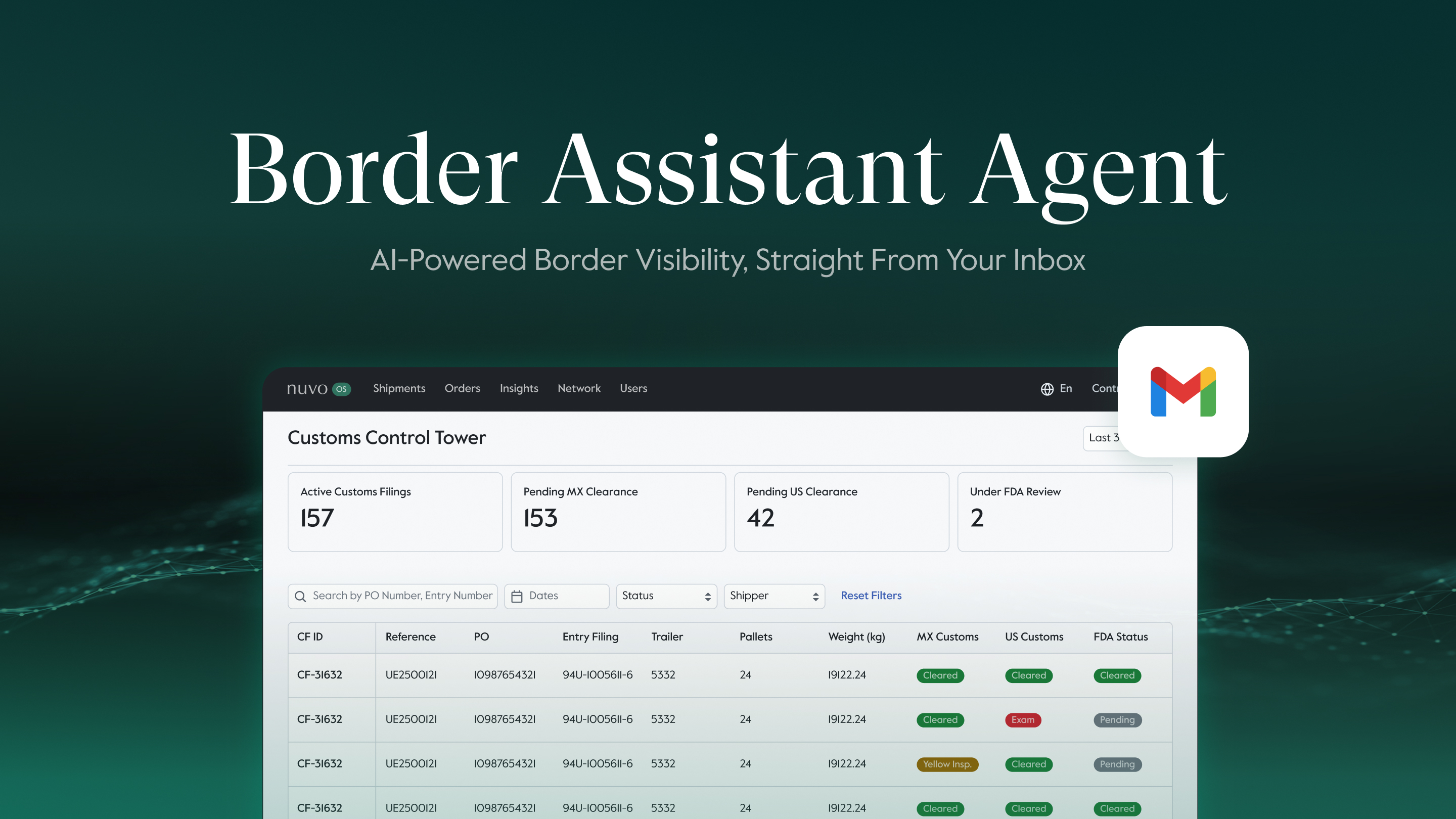
Every update on the shipment gets fed back to the Nuvo AI Control Tower, which captures all the information operators and logistics managers need in real-time. Facility-level performance — lead time, transit time, OTIF percentage, orders moved, health status — is surfaced automatically per origin and destination, so operations leaders can see where the network is strong and where it's slipping without building a BI report.
"With Nuvocargo, it's been smooth and seamless from beginning to end. I always hear it first from your team, no hesitation, with 100% transparency."— Kevin Aznar, Supply Chain Manager, Tanteo Tequila
95%+ consistent on-time delivery across all modes
Real-time exception intervention before service is impacted
Facility and lane performance live, without building a BI report
3. Radically simplifying your logistics tech stack
Ask any shipper with more than $5M in annual freight spend how many tools they manage. The answer is either "just a spreadsheet" or "way too many" leaving teams operating like it was 1999 or with massive complexity to manage. The digitization process begins reasonably. A spreadsheet gives way to a TMS (Oracle OTM, BlueYonder, MercuryGate). The TMS needs visibility, so a project44 or FourKites integration gets layered on. Rate intelligence from DAT, Greenscreens, or Sonar follows. Then a bidding platform (Emerge, Coupa, Jaggaer). Carrier compliance (Highway, GenLogs) becomes non-negotiable as fraud spreads across the industry. EDI and integrations. Freight audit and pay. BI and analytics. And now, with every startup in freight launching an AI product, a new layer of point solutions gets bolted on top — making the complexity worse, not better.
For the most sophisticated shippers we've worked with, this journey means managing 15–20 tools, 15–20 contracts, and 15–20 vendor relationships — none of which fully talk to each other. A subscription change in one can break the workflow in another. The stack is frail. The total cost is high. And it's not the future.
What Nuvo AI consolidates
Software category
Annual cost
Implementation fee
Setup + training
TMS
$200,000
$150,000
~12 months
Tracking
$75,000
$8,000
3 months
BI & Analytics
$59,940
-
>6 months
Procurement + Compliance
$57,600
-
3 months
EDI / API Integrations
$31,200
$1,500
6 months
Audit & Pay
$14,400
-
3 months
Rate Intelligence
$13,200
-
3 months
AI Point Solutions
?
-
>6 months
TMS
Annual cost
$200,000
Implementation fee
$150,000
Setup + training
~12 months
Tracking
Annual cost
$75,000
Implementation fee
$8,000
Setup + training
3 months
BI & Analytics
Annual cost
$59,940
Implementation fee
-
Setup + training
>6 months
Procurement + Compliance
Annual cost
$57,600
Implementation fee
-
Setup + training
3 months
EDI / API Integrations
Annual cost
$31,200
Implementation fee
$1,500
Setup + training
6 months
Audit & Pay
Annual cost
$14,400
Implementation fee
-
Setup + training
3 months
Rate Intelligence
Annual cost
$13,200
Implementation fee
-
Setup + training
3 months
AI Point Solutions
Annual cost
?
Implementation fee
-
Setup + training
>6 months
NuvoOS brings your stack into the AI era
Every function in that stack now runs on NuvoOS, our proprietary AI-native TMS. Orders flow in through the Order Intake Agent directly from the shipper's ERP. The Shipment Building Agent consumes tenders from email, EDI, or API, classifies them, extracts the data, and builds the shipment automatically. The Appointment Scheduling Agent contacts facilities directly to lock pickup and delivery windows before execution begins. After delivery, the Payment Agent closes the loop, automating invoice approval and carrier payment without the manual reconciliation that most brokerages treat as someone else's problem.
What was once 8 or more contracts, 8 or more logins, and 8 or more vendor relationships becomes one system, one dashboard, one account manager accountable to outcomes.
$500K–$1M eliminated or avoided in annual software spend, plus the coordination and training overhead of running 10+ point tools
70%+ of the end-to-end load lifecycle automated
~14 days to go live, vs. 6–12 months for a typical multi-tool rollout
4. Staying ahead on AI
We're living through a moment where AI evolves on a weekly basis. The vendor a shipper picked three months ago may already be obsolete. Companies that led in voice AI for freight or appointment scheduling in Q4 are already being undercut in Q2 as competitors enter and the cost equation shifts.
Over two years of evaluating 100+ AI vendors, one lesson has become very clear: you want to build your tech stack so you can always adopt the latest foundation model or the latest vertical tool that does the job well for any given part of the stack. Nuvo AI is holistic across the entire load lifecycle — from purchase order through carrier payment — and there are multiple product areas where we've already swapped vendors two or three times in the past year alone. We do that through a rigorous ROI exercise, backed by our own Silicon Valley engineering team on the cutting edge of AI. When we determine there's a way to drive better outcomes at lower cost — whether that's a newer vendor or something we can build directly on foundation models ourselves — we make that change on behalf of our shippers.
Humans on the account. Agents doing the work.
Our customers don't have to waste time thinking about the 25th new vendor pitch or the latest update from OpenAI or Anthropic. That work lives with us. Our engineering team runs rigorous ROI evaluations on every component of the stack, rebuilds agents on newer foundation models as they become available, and pairs that with dedicated account managers embedded on every customer account, backed by freight experts who have collectively moved 100,000+ loads at leading North American brokerages. Humans on the account. Agents doing the work.
That combination is what turns "AI ROI" from a theoretical promise into something measurable:
AI deployed with positive ROI in weeks, not months or years
14 days from pilot start to real performance data across cost, service, and visibility
Compounding operational intelligence so every shipment executed strengthens the system for the next
Nuvocargo vs. Traditional brokers
Category
Traditional Brokerage
Nuvocargo Managed Transportation
Pricing
All-in opaque rates
Direct carrier cost + fee
Carrier bids
Broker hides bids
You see every bid, every time
Carrier selection
Manual and subjective
Automated scoring + compliance + fraud checks
Rate negotiation
Human reps
AI-driven negotiation + instant awarding
Visibility
Periodic updates, fragmented
Single live dashboard for all shipments, tasks, bids & automations
NuvocargoSingle live dashboard for all shipments, tasks, bids & automations
Exception mgmt
TraditionalYou chase updates
NuvocargoWe intervene to ensure pickup & delivery
Communication
TraditionalHidden in someone else's inbox
NuvocargoEvery email chain visible in real time
Freight audit
TraditionalBroker checks invoices manually
NuvocargoAutomated POD + invoice auditing line-by-line
Ops workload
TraditionalYour team manages the shipment
NuvocargoYour team does nothing — we run the freight
Scope
TraditionalBrokered loads
NuvocargoEnd-to-end execution from PO → POD
What's coming next
Over the next several weeks, we'll publish a deep-dive post on each of the four outcomes, what we've built, what results we're seeing, and what it means for shippers evaluating their options:
Reducing freight spend: How the Quote, Negotiation, and Audit agents compound into 7–20% savings
Improving service levels: Continuous monitoring and proactive exception handling that hold 95%+ on-time
Radically simplifying your logistics tech stack: What one platform replaces, and the real cost of not consolidating
Staying ahead on AI: How we evaluate, swap, and ship upgrades so our customers don't have to
Beyond the series, our May "New on NuvoOS" update will cover the next wave of capability improvements, and our Q2 quarterly product update arrives at the end of June.
How to see it run on your freight
Nuvo AI runs alongside your existing tools, contracts, and carrier network. No rip-and-replace, no long implementation, no process mapping. Most teams start with as few as 10 live tenders. In 14 days, you'll have real performance data across cost, service, and visibility —on your lanes, against your carriers — to decide what comes next.
See these results run on your own freight.
Start with just 10 live tenders, and in 14 days, you'll have real performance data on your lanes to decide what comes next.